Common stones
| Stone | Character | Notes |
|---|---|---|
| Flagstone (sandstone, quartzite etc.) | Irregular, layered, natural | Thickness and density vary by source |
| Bluestone | Blue-gray, often cut to rectangles | Can get hot in full sun |
| Limestone / travertine | Soft, warm tones | Some types are acid-sensitive |
| Slate | Dark, cleft surface | Check freeze-thaw suitability |
| Granite | Very hard, durable | Flamed finishes improve grip |
Dry-laid vs. mortar-set
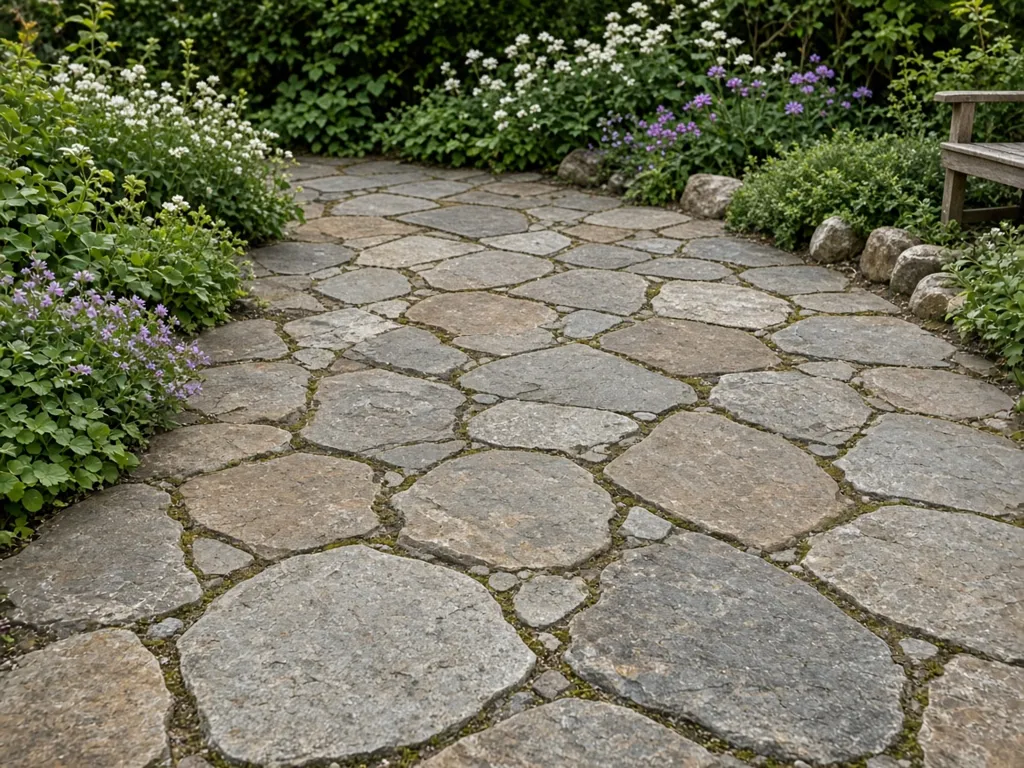
Dry-laid stone sits on a compacted base and bedding with sand, gravel or plants in joints—flexible and permeable. Mortar-set stone bonds to a concrete slab for a rigid, tight-jointed surface, which then depends on that slab staying sound.
Pros and cons
- Pro: unique, natural appearance that ages well
- Pro: many stones are very durable
- Con: thickness variation makes installation slower and more skilled
- Con: some stones stain, scale or are slippery when wet; ask suppliers about exterior and freeze-thaw suitability
Frequently asked questions
Is flagstone slippery?
Some smooth or honed stones are when wet. Cleft, thermal or textured finishes typically offer better grip.
Can I mix stone with pavers?
Yes; borders and inlays are common. Keep bases and heights compatible.